TWO:During his absence from the extreme south, General Graham, with about four thousand British and Portuguese, had quitted Cadiz by sea, and proceeded to Alge?iras, where he landed, intending to take Victor, who was blockading Cadiz, in the rear. His artillery, meanwhile, was landed at Tarifa; and on marching thither by land, over dreadful mountain roads, he was joined, on the 27th of February, by the Spanish General Lape?a, with seven thousand men. Graham consented to the Spaniard taking the chief command¡ªan ominous concession; and the united force¡ªsoon after joined by a fresh body of about one thousand men, making the whole force about twelve thousand¡ªthen marched forward towards Medina Sidonia, through the most execrable roads. Victor was fully informed of the movements of this army, and advanced to support General Cassagne, who held Medina Sidonia. No sooner did he quit his lines before Cadiz than the Spanish General De Zogas crossed from the Isle de Leon, and menaced the left of the French army. On this Victor halted at Chiclana, and ordered Cassagne to join him there. He expected nothing less than that Lape?a would manage to join De Zogas, and that fresh forces, marching out of Cadiz and the Isle of Leon, would co-operate with them, and compel him to raise the siege altogether. But nothing so vigorous was to be expected from a Spanish general. Lape?a was so slow and cautious in his movements that[15] Graham could not get him to make any determined advance; and on arriving at the heights of Barrosa, which a Spanish force had been sent forward to occupy, this body of men had quitted their post, and Victor was in possession of these important positions, which completely stopped the way to Cadiz and at the same time rendered retreat almost equally impossible. Lape?a was skirmishing, at about three miles' distance, with an inconsiderable force, and the cavalry was also occupied in another direction. Seeing, therefore, no prospect of receiving aid from the Spaniards, General Graham determined to attack Marshal Victor, and drive him from the heights, though the latter's force was twice as strong as the former's. This Graham did after a most desperate struggle. Had Lape?a shown any vigour or activity, Victor's retreating army might have been prevented from regaining its old lines; but it was in vain that Graham urged him to the pursuit. Lord Wellington eulogised the brilliant action of the heights of Barrosa, in a letter to Graham, in the warmest terms, declaring that, had the Spanish general done his duty, there would have been an end of the blockade of Cadiz. As it was, Victor returned to his lines and steadily resumed the siege. In the meantime, Admiral Keats, with a body of British sailors and marines, had attacked and destroyed all the French batteries and redoubts on the bay of Cadiz, except that of Catina, which was too strong for his few hundred men to take.
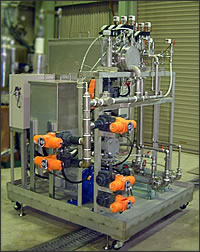
A hydrocyclone (liquid cyclone) injects treatment solution into stationary equipment to perform separation, classification, and concentration, and is an innovative separator with a very simple structure and no drive unit.
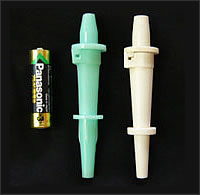
Structure of a hydrocyclone (liquid cyclone)
A suspension containing fine particles of several micrometers or more is supplied to a cylindrical container circumferentially at high speed. And as a result it starts to rotate and a centrifugal force is generated. At this time a gravitational acceleration of several tens of thousands of G is generated in the circumferential direction, and thus leading to fast sedimentation and concentration of the fine particles. The separated concentration can be freely selected by changing the supply rate (supply pressure and flow rate) and the flow ratio of the outlet. Our hydrocyclone (liquid cyclone) was designed and manufactured to classify and concentrate fine particles, and so has a small element.
THREE:SURRENDER OF THE PEISHWA. (See p. 141.)
- Equipment costs can be reduced.
- Operating costs can be reduced.
- Maintenance costs can be reduced.
- Any change in raw material and product can be easily addressed.
- Large amounts can be treated in a small area.
- Separation and cleaning are easy because of the simple structure.
- Simplified control
- This equipment can be operated in synchronization with external devices.
- Alarm and interlock mechanism.
THREE:Gates replied that he was well aware that General Burgoyne's army was reduced to the last extremity; that it had lost the greater part of its men by repeated defeats, sickness, etc., together with their artillery, horses, and ammunition; that their retreat was cut off, and, therefore, he could listen to nothing but an absolute surrender. Burgoyne said he would never admit that his retreat was cut off whilst he had arms in his hands; and Gates, who knew that Clinton was on his march, and might soon alter the whole face of things, was only too anxious to have Burgoyne's army out of the way. After some preliminaries, therefore, to save appearances, on the 16th it was agreed that the British should march out of their camp with all the honours of war; should deposit their cannon on the banks of the Hudson, and there pile their arms at the command of their own officers; that the troops, of whatever nation they might be composed, should retire in all security and honour to Boston, where they should be provided with all necessary comforts until they embarked for England, under condition of not serving against the United States again during that war; that the Canadians should be allowed to return in all honour to their own country; and that in no case should officers be separated from their own men. These were not such terms as are usually granted to conquered armies; and the reason was, that Clinton was every day drawing nearer. Scarcely were these terms agreed on, when this fact became known to Burgoyne. For a moment he hesitated whether he should sign the contract; but, on consultation with his officers, he felt himself bound in honour to ratify it, and accordingly, the next morning, the 17th of October, the deed was signed, and the troops, marching out, grounded their arms.
- Classification and concentration for the manufacture of inorganic powder materials
- Classification of ceramic materials
- Removal of fine particles, including iron powder
- Removal of fine particles from pigments
- Removal of fine organic particles from solvents
- Separation of starch and yeast
- Removal of fine particles from high-temperature strong acid solutions
- Removal of fine particles from low-temperature solutions